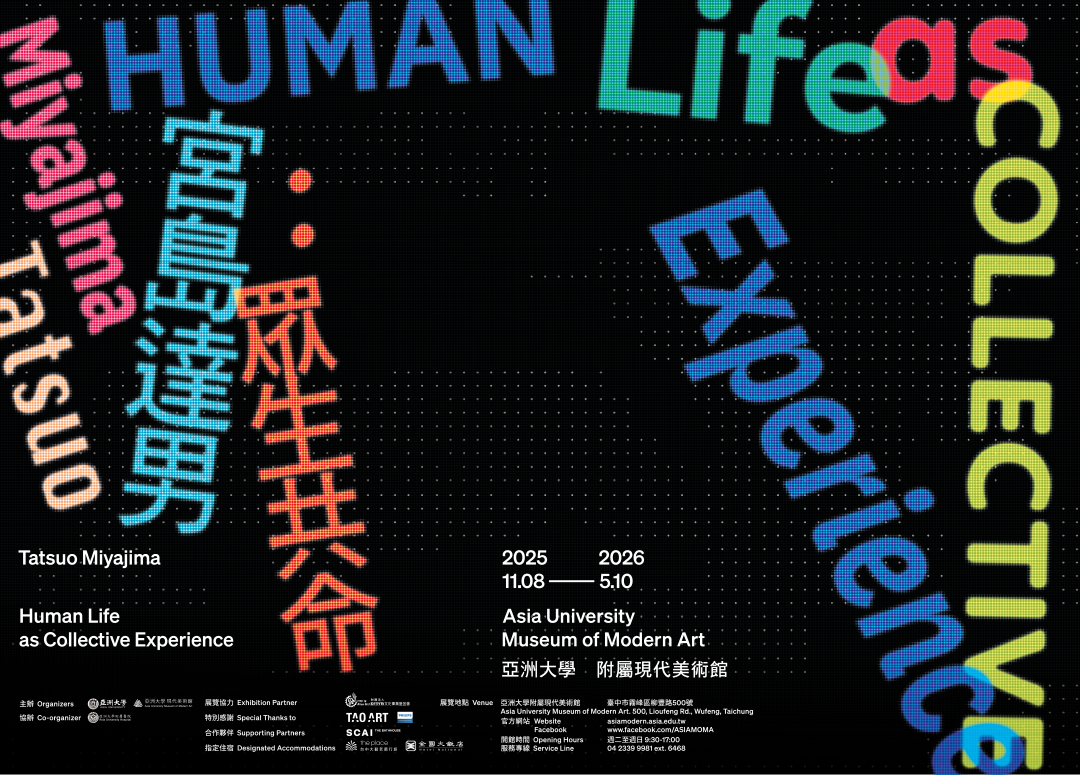

Tatsuo Miyajima: Human Life as Collective Experience
【活动日期】2025 年 11 月 08 日 - 2026 年 05 月 10日
【活动地点】亚洲大学附属现代美术馆
《众生共命:宫岛达男 Tatsuo Miyajima: Human Life as Collective Experience》
|艺术家:宫岛达男
|展期:2025/11/08 - 2026/05/10
|地点:亚洲大学附属现代美术馆
展览简介
我们所生活的这个世界,所有的生命,共享相同的阳光、空气、水;而这些生命,无论长短,皆有其诞生之日与终结之时的循环。「众生共命」这个主题提出两个思考的邀请:「众生」所指不仅是人,更包含了地球上的万千生命体;而「共命」则是思考人类的各式活动与行为对于他人及其他不同型态生命的影响。
因为童年多病住院的经验,享誉国际的日本新媒体艺术先驱宫岛达男发展出创作中对于生命的核心关怀,并以数字与倒数作为作品的主要元素。数字,存在于每个人的生命里,从出生的年月日,到我们遇见的人、事、物,无一不存在着数字的计数与纪录,影响了我们感知周遭世界的方式;倒数,象征着生命的流逝,而每一个人生命各异的起伏与感受,透过倒数的不同节奏呈现;数字0,则是宫岛作品中隐而不显的重要存在,象征着通往下一轮回的过渡,不发亮、却有其绝对重要的位置。
宫岛达男的艺术生涯从行为艺术开始,并于1980年代末期,伴随发光电子二极管(LED:light emitting diodes)的普及,开始大量运用LED以及积体电路数码计数器(IC [integrated circuit] digital counter)作为创作媒材而享誉国际。宫岛于42岁时便成为威尼斯双年展日本馆的代表艺术家,展览中由2400个计数器组合而成的大型空间装置〈幻灭|MEGA DEATH〉,看似是由程式与电子器材搭配的冰冷组合,然而在数字的明灭闪烁里却传递出他对于不同生命状态的深切关怀。
「众生共命」是宫岛达男于台湾首度的美术馆个展,集结了从1993年到2025年的经典作品、全新创作以及难得一见的创作计画和行为表演的概念图。展览中来自不同文化及语言的数字,各自有着不同的速度、音调或颜色,就像是世上众多个体在社群中彼此交织、共存的集体生命状态。这个跨越了超过三十年创作的展览并不是一个静态的、回顾式的展览,而是有着不同阶段参与及共同创作历程、并与在地脉络有紧密对话的个展。其中包含五件与台湾、雾峰及中亚联大参与者加入的共创作品,透过展览,希望反映出这个世界,我们不只是个人,更是彼此参与、互为依存的整体。
亚洲大学附属现代美术馆(亚美馆)迈入了第12年。从这个具有多重意义数字的这一年开始,亚美馆重新思考艺术的意义,以「亚洲性(Asia-ness)以及「健康福祉(Bene-esse/Well-being)」重新定位,思考艺术与人、人与环境及其他生命之间紧密的连结,并将美术馆化身为不同物种、物质与存在之间对话的平台。「众生共命」便是亚美馆转型的首档当代艺术大师展,邀请艺术家与美术馆携手合作,在数字倒数的影像与声音中,共同思考生命与环境的循环与连结。
在现代化的生活中,多数人共同居住在城市,却经常感到疏离,并难以连结自身与其他物种的关系。然而,每个人的生命,从来不是一段孤独的旅程,每一个个体,都是在与他人的关系、所处的文化与历史脉络中逐步形塑,进而构筑出属于所有生命的共同命运。亚美馆期待透过「众生共命」所提出的关心,邀请观众对于人与人之间相互支持、生命与生命之间紧密连结的网络展开更深刻的思考,将亚美馆转换成一个集结众生众声共存的所在。
All life in the world that we live in shares sunlight, air, and water equally, whereas these beings, regardless of their lifespans, have respective cycles from dawn to doom. The title “Human Life as Collective Experience” invites two enquiries: “life” refers to not merely humanity but also various beings on earth, while “collective” ponders over the impacts of human activities and behaviors on each other and other forms of life.
Stemming from the experience of frequent illness and hospitalization in childhood, the new media art pioneer from Japan, Tatsuo MIYAJIMA, develops his core concern about life in his practice and employs numbers and countdown as the key elements in his works. Numbers exist in our life. From the date, month, and year of birth to the people, things, and objects we encounter, number counting and recording are everywhere, shaping how we perceive the world around us. Countdown symbolizes the Passing of life, and the various fluctuations and experiences in our life are presented via the distinct varied rhythm of countdown. Number 0, a significant existence obscured in Miyajima’s works, represents the passage to the next cycle unlit, yet securing an absolutely vital position.
Tatsuo Miyajima took on his art career with performance art. In the late 1980s, following the popularization of light emitting diode (LED), the artist has been known to the world by using a myriad of LEDs and IC (integrated circuit) digital counters as his mediums. At his 42, Miyajima became the representative artist of the Japan Pavilion in the Venice Biennale. Mega Death, a large-scale spatial installation artwork consisting of 2400 counters, appears to be a cold combination of programs and electronic devices, and nevertheless, amidst the flickering numbers, his ardent concern for different states of life is evinced.
“Human Life as Collective Experience” is Tatsuo Miyajima’s first solo museum exhibition in Taiwan, featuring the artist’s classical works from 1993 to 2025, newly created artworks, as well as rarely-seen concept drawings for creative projects and performance art. The numbers in the exhibition, coming from various cultures and languages, are imbued with distinct speed, tone, or color, symbolizing the state of collective existence of numerous individuals around the world, intertwining and coexisting in communities. This exhibition featuring oeuvre spanning over three decades is not a static retrospective. Instead, it is a solo exhibition involving different stages of participation and journeys of co-creation, engaging in an intimate dialogue with the local context. With five collaborative works produced with participants from Taiwan, Wufeng, and the China Medical University - Asia University System, what the artist seeks through the exhibition is to reflect that we are more than individuals, rather a collective with everyone involved and interdependent on each other.
This year marks the 12th year of Asia University Museum of Modern Art (Asia Modern). Starting from this 12th year with a number of multiple implications, Asia Modern reconsiders the meaning of art, repositioning itself with “Asia-ness” and “Bene-esse” (Well-being). Pondering over the intimate ties of art with humanity and that of the human race with the environment and other beings, the museum is transformed into a platform for conversations between myriad species, materials, and existence. “Human Life as Collective Experience”, as the first exhibition of modern art masters after Asia Modern’s transformation, invites artists to work with the Museum, amidst the visuals and audios of numerical countdown, to collectively reflect on the cycles and connections of life and the environment.
In the modernized lifestyle, most people dwell in the cities together, yet often feel alienated, and hard to connect themselves with other species. However, individual life is never a lonely journey. Every individual is gradually shaped by the relationships with others as well as the cultures and historical contexts they are situated in, which in turn constructs the destiny shared by all beings. Through the concern proposed by “Human Life as Collective Experience,” Asia Modern invites visitors to engage in a deeper thinking over the closely network of all beings, where people support each other, transforming Asia Modern into a space where multitude of life and voices converge and coexist.
【联络资讯】 亚洲大学附属现代美术馆 04-2339-9981分机 6464
【主办单位】亚洲大学现代美术馆
★所有活动相关资讯,以【主办单位:亚洲大学附属现代美术馆】官方网站及脸书粉丝专业公告为主,详情请洽各主办单位★
--------